

Las Vegas slipstream set to produce a Monza-style race, drivers say
Max Verstappen starts the Las Vegas Grand Prix from pole, but drivers expect a tight pack because of the slipstream. George Russell says it is the strongest he has experienced in any category.
· 3 min read
In brief
- Verstappen starts from pole in Las Vegas after Antonelli's penalty.
- Verstappen says a good tow was worth 7–8 tenths over one lap.
- Russell says the slipstream is stronger than in any category he has raced in.
- Antonelli expects it to be close to impossible to pull away in the race.
Seven or eight tenths in a single lap
Max Verstappen will start the Las Vegas Grand Prix from pole position after Andrea Kimi Antonelli's penalty. Yet the Red Bull driver's main topic after qualifying was the tow, or slipstream: the reduced drag a car enjoys when running close behind another.
Verstappen said he came close to being knocked out in Q2. On his final lap he was four to four and a half seconds behind another car and gained 7–8 tenths, despite not being much quicker through the corners. He did the same on his first run in Q3. "It's just insane how much you gain on the straights," he said.
Why is the effect so strong?
According to RaceFans, the slipstream has become more powerful since Formula 1 cut the energy harvesting limit of the power units. The change was meant to reduce the large closing-speed differences seen earlier in the season.
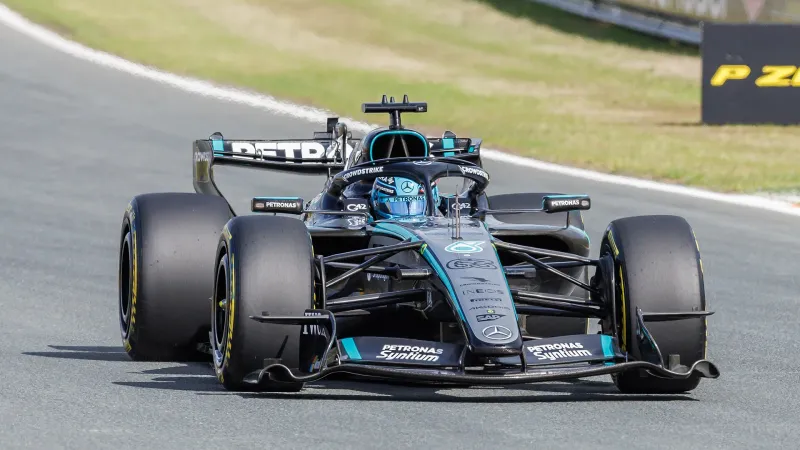
George Russell said many people are confused by the effect. He is not sure whether it comes purely from Straight Mode, which may create a strange disturbance in the air, or whether energy deployment also plays a part: if the deployment lasts a little longer, cars are on a power offset for half the straight. He said the slipstreams are more extreme than anything he has experienced in any category.
Another factor will come into play on Sunday. Overtake Mode gives extra power to any driver within a second of the car ahead.
Antonelli: pulling away will be impossible
Antonelli expects a race along the lines of the Italian Grand Prix, where the leader could not break free of the chasing pack. "If Monza was difficult, here it's probably going to be impossible," he said.
The Mercedes driver said following closely costs plenty of downforce in the corners, but the tow gives it back on the straights, and more besides. He has struggled over a single lap, though the car felt good on long runs. He won in Italy from 19th on the grid and lines up sixth in Las Vegas, so he expects plenty of chances to attack.
What does it mean?
After round 20 Antonelli leads the drivers' standings on 390 points, 111 clear of Verstappen on 279. Behind them, third to sixth is tight: Russell has 262, Lewis Hamilton 261, Charles Leclerc 249 and Lando Norris 246. Just 16 points separate the four.
Ferrari's pair of Hamilton and Leclerc failed to reach Q3. If the drivers' predictions are right, it will be possible to move forward from the back, so the race will not be decided on the grid. In the constructors' standings Mercedes lead on 652 points, with Ferrari second on 510.
Round 21 takes place on Sunday, and the first lap should show how far the drivers' expectations hold true.
- 7–8 tenths
- Verstappen's slipstream gain in a single lap
- 6th
- Antonelli's grid position
- 111 points
- Antonelli's lead over Verstappen after round 20
- 1 second
- Overtake Mode activation window
Paddox poll
Who will win the Las Vegas Grand Prix?
Enjoyed it? Share it!
Sources
This article was produced with the help of artificial intelligence, based on the sources listed. How we work
Comments
Comments are reviewed by automated moderation every four hours; anyone can report unlawful content. Rules