
Verstappen’s 2030 F1: lighter cars, simpler engines, push-to-pass
After winning in Las Vegas, Max Verstappen used the Qatar media session to set out what Formula 1 should chase in 2030: lighter cars, a more natural power unit, and fewer artificial straight-line tricks.
· 3 min read
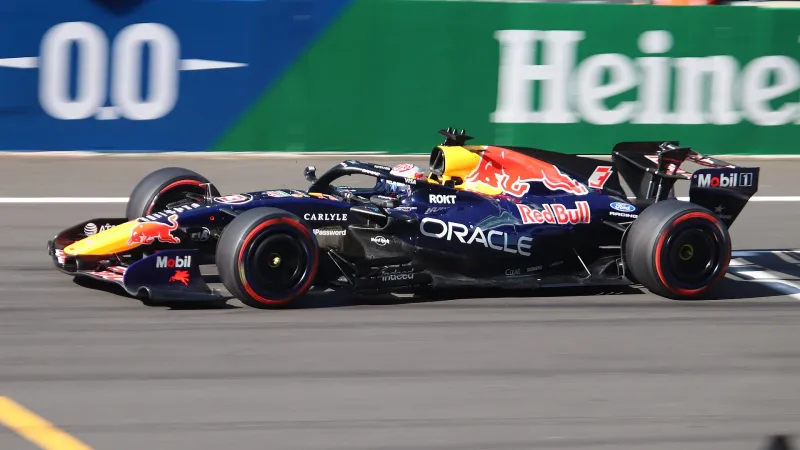
In brief
- Verstappen wants lighter 2030 cars and less reliance on DRS, with high straight-line drag instead.
- He accepts push-to-pass if the engine is simpler and hybrid power does not override the throttle.
- The FIA has outlined a 2.1-litre turbo V8 with limited hybridisation for 2030.
Fresh from a chaotic Las Vegas Grand Prix that produced 352 overtakes, Max Verstappen used the pre-Qatar media session at Lusail to describe the Formula 1 he wants when the next major regulation overhaul arrives in 2030. The four-time world champion bluntly likened the Nevada race to “playing Mario Kart”: it looked good on television, he said, but it was not how Formula 1 should be raced.
Lighter cars, less artifice on the straights
His starting point was unambiguous: cut the weight, drop artificial straight-line aids, and stop letting electrical harvesting dictate how a driver attacks a lap.
“Well, I mean lighter cars for sure,” Verstappen said. From the 1980s to 2010, he noted, dominant cars were sometimes a second or two a lap quicker. He does not expect that gap to return, but he can still imagine a formula in which a car is deliberately high-drag in a straight line, so drivers rely far less on DRS — the system that opens the rear wing and adds straight-line speed.
The 2026 technical rules did shrink the cars and cut the minimum weight from 800 kg to 768 kg. The near 50–50 split between combustion and electric power — lifting MGU-K output from 120 kW to 350 kW after the MGU-H was dropped — has, however, put heavy emphasis on battery harvesting. In Nevada, Verstappen conceded the spectacle worked for television while insisting: “For me personally this isn’t Formula 1, the way that we are racing. It looks great on TV, but this isn’t how it should be.”
Natural throttle, limited hybrid
He does not want overtaking aids banned outright — only an engine that behaves naturally under the driver’s right foot. A push-to-pass system, extra power the driver can deploy for a short burst, is “fine” with him, provided it is “a much easier engine”.
Show runs in an RB7, he said, still feel right: the throttle responds, the car is not shaking about, there is no lag. That is nicer to drive than the current machinery. He accepts some hybrid element and a turbocharger, not least because otherwise the cars would be too loud for some venues. What he will not accept is hybrid hardware overrunning the natural driving element, “which of course at the moment is happening”.
Red Bull’s 2011 championship-winning RB7 weighed 640 kg including the driver — 128 kg lighter than today’s cars — and paired a naturally aspirated 2.4-litre Renault V8 revving to 18,000 rpm with a compact KERS unit.
The 2030 framework is already close
Verstappen’s wishlist sits close to the direction the sport’s power brokers locked in last week. On 20 November in Las Vegas, the FIA announced a unanimous agreement with Formula 1, the teams and the manufacturers on a 2030 power-unit framework: a 2.1-litre turbocharged V8 running on advanced sustainable fuels, with limited hybridisation. Eight-cylinder engines would return for the first time since 2013, and the current 2026 engine era would be cut short by a year. Formal approval is due at the FIA World Motor Sport Council in Shanghai next month. President Mohammed Ben Sulayem pledged the rules would marry the V8 to “lighter, simpler and more affordable cars that put driver skill at the heart of the competition.”
On the calendar he stayed pragmatic. Smaller 2030 cars do not, by themselves, reopen a path to old-school circuits. Venues already host plenty of racing; from Formula 1’s side, the commercial pull of city-centre street races and hospitality still weighs heavily.
What it means
The critique from a champion in 2021, 2022, 2023 and 2024 is not an outlier. The 2030 power-unit direction already points towards lighter, simpler cars with less electrical dominance. High-drag concepts, push-to-pass and a more natural throttle response sit in the same package as the V8 framework the FIA has sketched — provided Shanghai gives it formal assent.
- 352
- overtakes in Las Vegas
- 768 kg
- 2026 minimum weight
- 640 kg
- 2011 RB7 with driver
- 2.1 L
- planned 2030 turbo V8
Paddox poll
What would improve Formula 1 for 2030?
Enjoyed it? Share it!
Sources
- Max Verstappen details his ideal 2030 F1 Formula (Motorsport.com F1)
This article was produced with the help of artificial intelligence, based on the sources listed. How we work
Comments
Comments are reviewed by automated moderation every four hours; anyone can report unlawful content. Rules