
FIA to freeze current F1 power units from mid-2028 before V8 switch
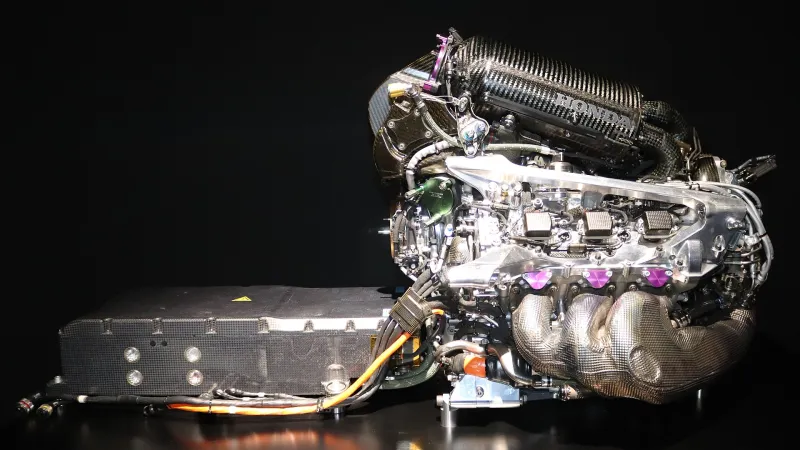
Manufacturers must stop developing today’s hybrid V6s from the 13th race of 2028. Dyno work on the 2030 2.1-litre turbo V8 is tightly gated until the same window, with ADUO still unresolved.
· 2 min read
In brief
- Current hybrid V6 development freezes from the 13th race of 2028.
- Only reliability updates are allowed after that; no performance upgrades.
- 2030 V8 dyno work is barred until 1 October 2027 (single cylinder) and 1 July 2028 (full PU).
- ADUO is still under review; GM/Cadillac as a newcomer may simulate earlier.
Formula 1 manufacturers will no longer be allowed to develop the current generation of power units from mid-2028. Nikolas Tombazis, the FIA’s single-seater director, has confirmed that hybrid V6 work will freeze from the 13th race of the 2028 season, while work on the 2.1-litre turbocharged V8 planned for 2030 is largely prohibited until that same point.
The measure, first made public over the Las Vegas Grand Prix weekend, has been agreed with all parties. It is designed to stop manufacturers running two programmes at once and to stop those already competitive under today’s rules from switching their focus to 2030 earlier than those still chasing.
Reliability only after the freeze
From that 13th round, only reliability updates will be permitted; performance upgrades will not. 1 July 2028 roughly coincides with that race, and is also the date from which existing manufacturers may dyno-test a complete V8.
Until then the 2030 engine is tightly constrained. Single-cylinder dyno work is banned until 1 October 2027, and full power-unit dyno running until 1 July 2028. Newcomers are exempt: General Motors may begin simulation work for the Cadillac unit earlier.
Cost, advantage and Honda
Without a freeze, the governing body fears spiralling costs and an uncontrolled development race. It also wants to avoid a manufacturer — Honda is the example given — still sitting well behind when the freeze bites.
“We've been concentrating on the PU framework and, frankly speaking, we are a bit late on the ADUO side,” Tombazis said. Cost is the first motive: two parallel programmes are what the FIA wants to avoid. The second is competitive: a strong current PU maker could stop early, leaving those still catching up at a disadvantage.
What it means
The freeze is not a green light for 2030 V8s; it is a pause so that today’s hybrids can converge first. Tombazis does not want anyone “frozen” while still a long way down. A rethink of ADUO — the mechanism intended to even up power units — is seen as necessary in the paddock, but no final decision has been taken. That, and other delicate questions, must be settled before mid-2028 locks in performance.
- 13th
- 2028 race from which the V6 freeze applies
- 1 July 2028
- full V8 dyno testing may begin
- 1 Oct 2027
- single-cylinder dyno ban lifts
- 2.1-litre
- capacity of the 2030 turbo V8
Paddox poll
Does the 2028 engine freeze protect manufacturers still catching up?
Enjoyed it? Share it!
Sources
- FIA details F1 engine freeze and imposes testing restrictions ahead of V8 return (Autosport)
- FIA confirms F1 engine freeze and imposes testing restrictions ahead of V8 return (Motorsport.com F1)
- Befagyasztják az F1-es motorok fejlesztését 2028-ban (F1világ)
This article was produced with the help of artificial intelligence, based on the sources listed. How we work
Comments
Comments are reviewed by automated moderation every four hours; anyone can report unlawful content. Rules