
Sainz wants 2030 overtaking boost at corner exit, not at top speed
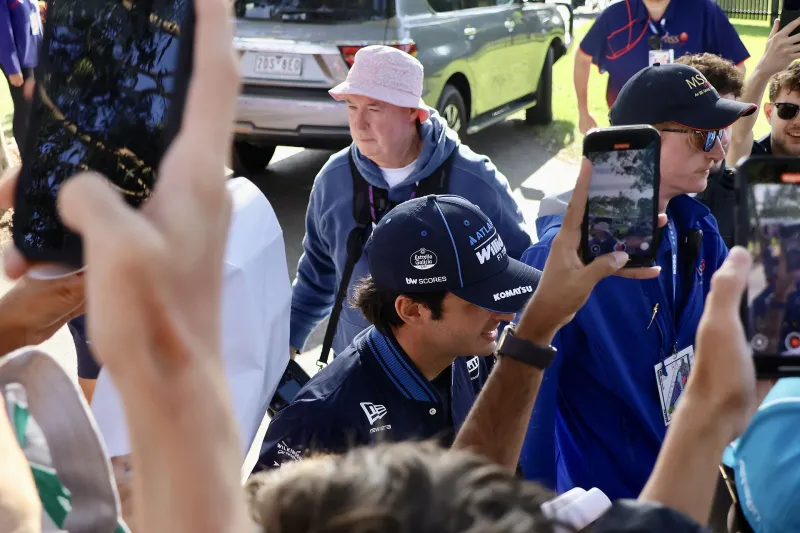
Williams driver and GPDA director Carlos Sainz has outlined a DRS-style idea for Formula 1’s 2030 turbo V8 era: extra power as cars leave the corner, to recover dirty-air losses, not a late-straight speed dump that makes defending impossible.
· 3 min read
In brief
- Sainz wants 2030 overtaking boost at corner exit to recover dirty-air losses, not a late-straight speed dump.
- The V8 framework is due to be signed off at the FIA World Council in Shanghai on 12 December.
- KERS thinking: 100 kW standard, 100 kW boost, 200 kW harvest; DRS on the rear wing is not ruled out.
- Verstappen asked whether draggy cars could reduce the need for DRS.
Carlos Sainz has put a clear stamp on how Formula 1 should help overtaking once it switches to turbo V8 power units in 2030. The Williams driver, who also sits as a director of the Grand Prix Drivers’ Association, wants any DRS-style or push-to-pass boost to arrive as cars leave the corner — restoring what is lost in dirty air — rather than inflating the speed gap at the end of the straight.
The new engines are planned with a smaller electric unit of up to 200 kW and sustainable fuel, aiming for simpler, cheaper and lighter hardware and less reliance on the battery than the current formula. Signing off the V8 tenets at the FIA World Motor Sport Council in Shanghai on 12 December would give F1 and the FIA time to write chassis and aerodynamic rules that work with those power units.
Boost out of the corner, then leave the pass to the driver
Sainz’s starting point is familiar: following a car costs cornering speed in turbulent air. A burst of extra power at the exit would help the chasing driver get back into a tight slipstream. From there, the draft and the braking zone would decide the move — not an artificial surge at terminal velocity.
I think the delta on speed should come more at the beginning of the straight when you are trying to get the slipstream rather than at the end of the straight when the overtaking and the delta speed is too high. It would also leave more overtaking down to driver skill rather than simply sailing past the car in front.
In his words, overtake mode, push-to-pass or DRS — “whatever you want to call it” — should happen exiting the corner so the boost makes up what was lost, but should not finish the overtake for you.
A 30 km/h gap that stops drivers defending
Sainz also pointed to a safety and racing problem with today’s DRS passes: closing-speed gaps of 30 km/h at the top end. The car in front becomes reluctant to cover the inside because the attacker arrives too quickly. Shifting the advantage to the exit would avoid that dangerous deficit. He would still tie the aid to a distance threshold — something you earn by living in dirty air and getting close enough, not a free gift anywhere on the lap.
Las Vegas, KERS and whether DRS returns
Last weekend’s Las Vegas Grand Prix produced a record 35 lead changes, helped by a strong slipstream and the power unit’s boost mode. The result was yo-yo racing, with the lead car often a sitting duck on the straight. That has fed a debate about whether F1 wants more of that spectacle or whether it felt too artificial — and it underlined how power-unit maps and aero overtaking aids need to be tunable from race to race without making passing trivial.
Current thinking for the next KERS unit is 100 kW of electric energy in standard mode, another 100 kW of boost accessed in a way that is not fully defined, and a total harvest of 200 kW. The next engines would no longer require active aerodynamics, but the FIA has not ruled out pairing push-to-pass with a return of DRS on the rear wing.
Max Verstappen floated a different path: make the cars draggy enough in a straight line that DRS is less necessary. He is comfortable with push-to-pass, provided the engine itself is much simpler.
What it means
Sainz is not arguing against the V8 itself. He is arguing about when the overtaking aid should fire. If extra energy only restores the slipstream after dirty air, defending and late braking stay in the drivers’ hands instead of a 30 km/h fly-by. Once Shanghai signs off the power-unit direction on 12 December, that is exactly the chassis and aero brief F1 has to write — with or without a rear-wing DRS flap.
- 2030
- planned turbo V8 formula
- 35
- lead changes at the Las Vegas Grand Prix
- 200 kW
- planned electric harvest
- 30 km/h
- top-speed delta Sainz says deters defending
Paddox poll
Where should F1 put the 2030 overtaking aid?
Enjoyed it? Share it!
Sources
- Carlos Sainz explains his intriguing DRS proposal for F1 2030 (Motorsport.com F1)
- Sainz proposes intriguing DRS solution for F1 2030 (Autosport)
This article was produced with the help of artificial intelligence, based on the sources listed. How we work
Comments
Comments are reviewed by automated moderation every four hours; anyone can report unlawful content. Rules